


Crossbows are built to deliver power, precision, and reliability, but like any piece of sporting equipment, they need regular care to perform at their best. Learning how to maintain a crossbow is essential whether you’re a beginner who has just purchased your first model or an experienced hunter preparing for another season. Proper maintenance helps preserve accuracy, reduces unnecessary wear, and can prevent potentially dangerous equipment failures.
The good news is that crossbow maintenance doesn’t have to be complicated or expensive. Most routine care involves inspecting the strings and cables, keeping components clean, applying manufacturer-approved lubricants, and storing your crossbow correctly.
In this guide, we’ll explain everything you need to know about maintaining your crossbow, including what to check before and after shooting, how often to perform maintenance, which products to use, and when professional servicing is necessary.
This article contains affiliate links. We may earn a commission from qualifying purchases at no additional cost to you.
Table of Contents
Why Regular Crossbow Maintenance Matters
A modern crossbow contains several components working together under considerable mechanical tension. The bowstring, cables, limbs, cams, trigger mechanism, and rail must all remain in good condition for the crossbow to operate safely.
Without regular maintenance, even a high-quality crossbow can experience problems.
Common consequences of neglected maintenance include:
- Reduced accuracy: Worn strings, loose components, or damaged arrows can affect consistency.
- Premature string wear: Friction and exposure to moisture can shorten the lifespan of strings and cables.
- Mechanical problems: Dirt, debris, and corrosion may interfere with moving components.
- Higher repair costs: Minor issues can develop into expensive repairs if ignored.
- Safety risks: Damaged strings, limbs, or other components can fail under tension.
Routine maintenance is particularly important for hunters who expose their equipment to rain, mud, dust, and changing temperatures.
However, even crossbows used exclusively at a shooting range benefit from regular inspections and cleaning.
If you’re still deciding which type of crossbow is right for you, our How to Choose a Crossbow (Beginner’s Guide) explains the key differences between models and the features worth considering.
How to Maintain a Crossbow: Step-by-Step
Maintaining a crossbow involves several straightforward tasks. Although the exact requirements vary between manufacturers and models, the following steps cover the most important aspects of routine maintenance.
1. Inspect the Crossbow Before Every Use
The most important maintenance habit is performing a visual inspection before shooting.
A crossbow operates under significant stored energy, so damaged components should never be ignored.
Before each shooting session, inspect the following:
Bowstring and cables
Look for fraying, broken strands, unusual stretching, damaged serving, or excessive wear around contact points.
Some minor surface fuzzing may be normal, but exposed or broken strands are a warning sign.
Limbs
Check for cracks, splintering, unusual marks, or signs of delamination.
If you suspect limb damage, stop using the crossbow immediately and arrange an inspection by a qualified technician.
Cams and pulleys
On compound crossbows, visually inspect the cams for obvious damage, debris, or irregularities.
Avoid attempting to adjust cam timing or cable tension yourself unless you’re qualified and equipped to do so.
Rail and flight track
Check for dirt, debris, corrosion, or unusual wear.
Scope and mounting hardware
Ensure the scope is securely mounted and that there are no obvious loose or damaged components.
Do not overtighten screws. Follow the manufacturer’s torque specifications.
Safety mechanism
Confirm that the safety and other manufacturer-provided safety features operate as described in the owner’s manual.
Never test the trigger or safety on a loaded crossbow outside the manufacturer’s prescribed procedure.
A quick inspection takes only a few minutes and can help prevent serious problems.
For a more detailed explanation of safe handling practices, read our Crossbow Safety Basics for New Owners.
2. Clean the Crossbow After Shooting
Dirt, dust, moisture, and debris can gradually accumulate on a crossbow, particularly after hunting trips or outdoor range sessions.
Cleaning the crossbow regularly helps protect its finish and keeps components in good condition.
Before cleaning, ensure the crossbow is unloaded and uncocked, following the manufacturer’s approved unloading or de-cocking procedure.
Cleaning the exterior
Use a soft, dry microfiber cloth to remove dust, fingerprints, and surface dirt from the stock, limbs, and other accessible surfaces.
For stubborn dirt, use a slightly damp cloth if permitted by the manufacturer, followed by thorough drying.
Avoid soaking components or spraying cleaning solutions directly onto the crossbow.
Cleaning the rail
Inspect the rail or flight track for accumulated debris.
Use a clean, lint-free cloth to remove dirt and residue.
Avoid abrasive materials that could damage the surface.
Cleaning the scope
Use a lens brush or air blower to remove loose dust before gently cleaning the lenses with an appropriate optical cleaning cloth.
Never use household glass cleaners unless the scope manufacturer specifically permits them.
Cleaning after wet conditions
If you’ve been shooting in rain or damp conditions, dry the accessible surfaces as soon as practical.
Pay particular attention to metal fittings, mounting hardware, and other areas where moisture may collect.
Do not use high heat, such as a hairdryer, to accelerate drying.
Allow the crossbow to dry naturally in a well-ventilated environment.
3. Wax the Crossbow String
Bowstring maintenance is one of the most important aspects of caring for a crossbow.
Crossbow strings experience substantial stress during operation. Appropriate string wax helps protect exposed fibres against moisture and abrasion.
However, not every part of the string should be waxed.
Where should you apply string wax?
Apply a small amount of manufacturer-approved bowstring wax to the exposed, unserved sections of the string, following the owner’s manual.
Avoid applying wax to:
- The centre serving unless specifically instructed.
- Areas where the manufacturer prohibits lubrication.
- Cams, pulleys, or trigger components.
- The rail or flight track.
Excess wax can attract dirt and create unnecessary residue.
How often should you wax a crossbow string?
There is no universal schedule.
Some manufacturers recommend waxing after a particular number of shots, while others base maintenance on visible string condition or environmental exposure.
Follow your specific model’s instructions.
If the exposed string fibres begin to look dry or fuzzy, check the manufacturer’s guidance before applying more wax.
Remember that waxing cannot repair broken strands or damaged serving. A damaged string must be assessed and, where necessary, replaced.
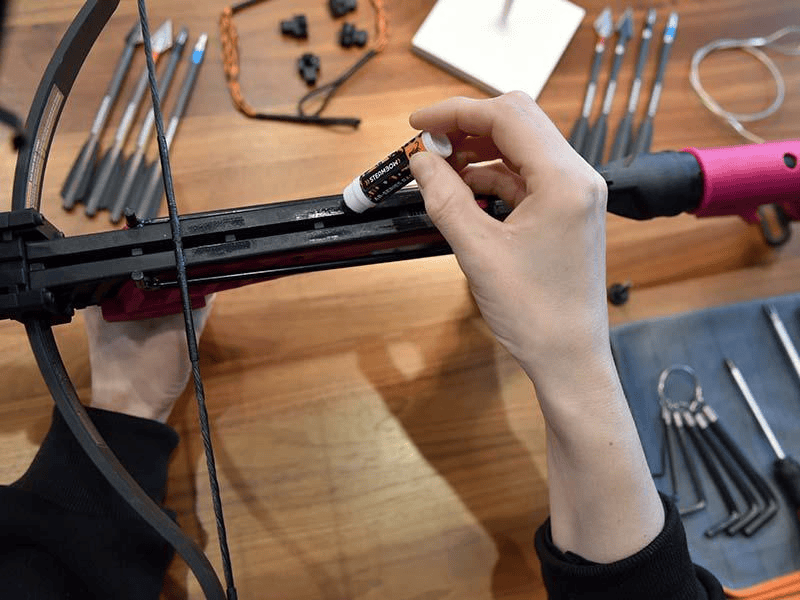
4. Lubricate the Rail and Other Approved Components
Proper lubrication can reduce friction and protect certain components from premature wear.
However, this is an area where crossbow owners need to be particularly careful.
Different crossbow designs have different lubrication requirements.
Some manufacturers recommend applying rail lubricant periodically. Others use specialised systems that require different products or procedures.
Never assume that every crossbow needs rail lubricant.
If your manufacturer recommends rail lubrication:
- Confirm the correct lubricant for your model.
- Make sure the crossbow is unloaded and uncocked.
- Clean the relevant surface.
- Apply only the quantity specified in the owner’s manual.
- Remove excess product if instructed.
Do not substitute general-purpose oils, grease, or household lubricants for manufacturer-approved products.
Similarly, avoid applying oil to the trigger assembly, cams, or internal mechanisms unless the manufacturer specifically directs you to do so.
Using the wrong lubricant can attract debris, damage materials, or interfere with normal operation.
Here is a popular crossbow rail lubricant.
Special Maintenance Considerations for Ravin and TenPoint Crossbows
Not all crossbows should be maintained using the same products or procedures.
For example, TenPoint recommends periodic lubrication of certain flight rails, cams, and trigger components, depending on the model.
Ravin crossbows have substantially different requirements. Ravin advises against using conventional bowstring wax, rail lubricant, or oil in its trigger and Trac-Trigger systems. Instead, it recommends approved non-wax serving fluid for specified string and cable components.
String replacement intervals can also differ. Ravin’s published recommendations include 400 shots or two years for many models, while certain models require replacement after 200 shots or two years, whichever comes first.
Always consult the owner’s manual for your exact model before applying maintenance products.
For additional manufacturer-specific advice, TenPoint provides a useful crossbow maintenance FAQ covering lubrication, string care, storage, and routine inspections.
5. Inspect the Arrows and Nocks
Crossbow maintenance doesn’t stop with the crossbow itself.
Arrows are an essential part of the system, and damaged or incompatible arrows can create significant safety risks.
Before each shooting session, inspect your arrows for:
- Cracks or splits in the shaft.
- Bent or damaged components.
- Loose inserts or points.
- Damaged or missing vanes.
- Cracked, loose, or worn nocks.
Carbon arrows deserve particular attention because some damage may be difficult to see.
Follow the arrow manufacturer’s inspection procedure and discard any arrow suspected of structural damage.
Never shoot a visibly damaged arrow.
It’s equally important to use arrows that meet the crossbow manufacturer’s specifications for length, weight, diameter, and nock design.
Using arrows that are too light or otherwise incompatible may damage the crossbow or create dangerous firing conditions.
For hunters, broadheads should also be inspected for damage and stored in a suitable protective container.
6. Check the Scope and Mounting System
A crossbow scope can gradually lose its alignment if mounting components loosen or become damaged.
Before shooting, visually inspect the scope, rings, and mounting system.
Check for obvious movement, damage, or missing hardware.
If screws require tightening, use the manufacturer’s specified torque values rather than guessing.
Overtightening can damage scope tubes, mounting hardware, or threads.
After maintenance, transportation, or any incident that might affect alignment, confirm the crossbow’s point of impact at a suitable range before relying on it for hunting.
Our guide on How to Sight In a Crossbow Scope explains the process of checking and adjusting your scope.
7. Store Your Crossbow Properly
Correct storage can significantly extend the lifespan of a crossbow.
Moisture, extreme temperatures, direct sunlight, and improper handling can all contribute to unnecessary wear.
For long-term storage, choose a clean, dry, secure location with relatively stable temperatures.
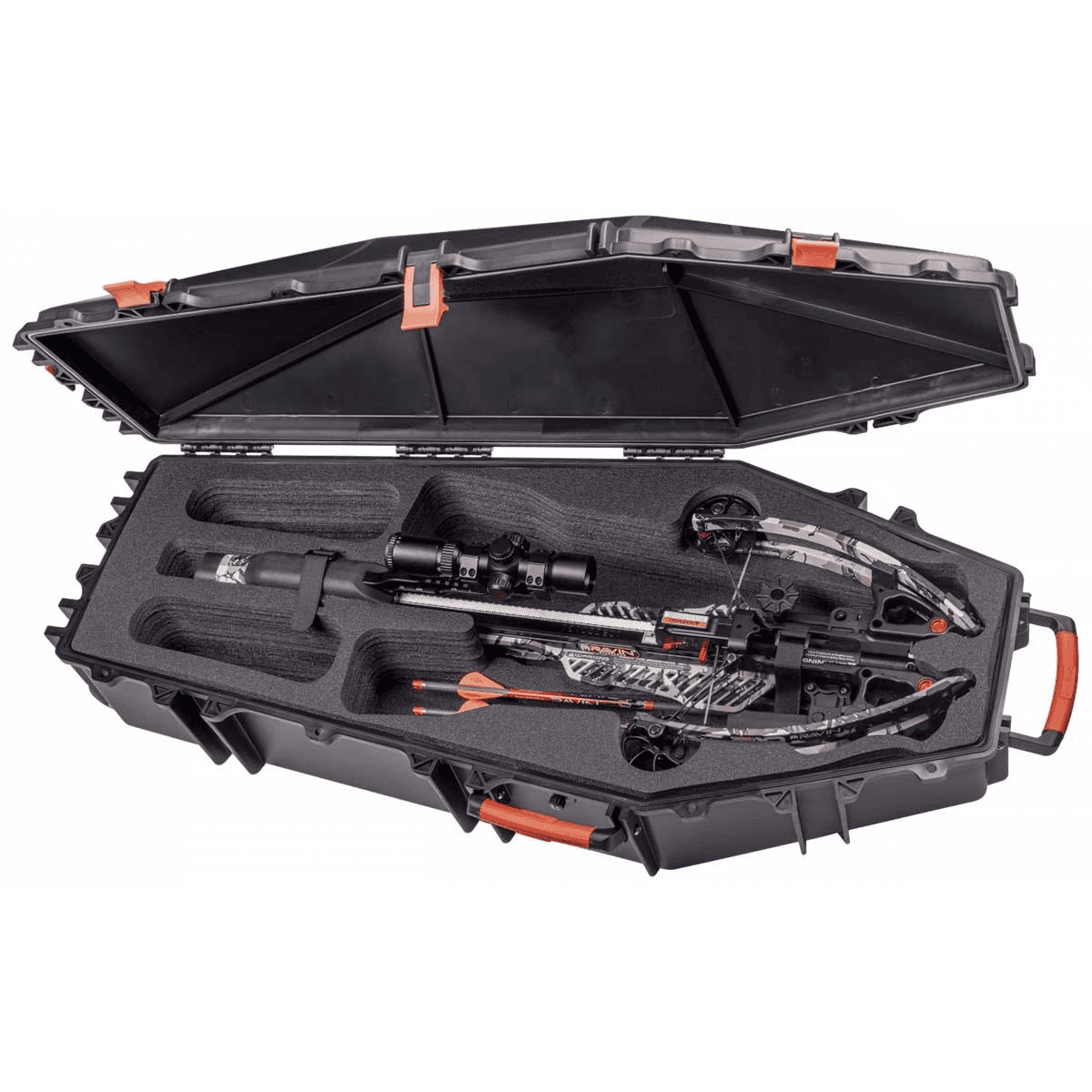
Use a suitable crossbow case
A padded crossbow case can protect the scope, stock, and limbs from accidental knocks during transport and storage.
Hard cases offer additional protection, particularly when equipment is transported frequently.
However, avoid sealing a damp crossbow inside a case for extended periods.
Avoid extreme temperatures
Do not leave your crossbow in a hot vehicle or exposed to prolonged direct sunlight.
Excessive heat can affect certain materials, adhesives, and accessories.
Similarly, avoid storing the crossbow in areas with persistent dampness or condensation.
Never store a crossbow cocked
As a general rule, crossbows should be stored unloaded and uncocked.
Always follow the manufacturer’s approved de-cocking procedure.
Some crossbows include integrated de-cocking systems, while others require a specific approved method.
Never attempt to release the string manually or dry-fire the crossbow.
Store ammunition separately and securely
Keep arrows and broadheads protected and inaccessible to children or unauthorised users.
A lockable case or secure storage area provides additional protection.
How Often Should You Maintain a Crossbow?
The ideal maintenance schedule depends on how frequently you shoot, the conditions in which you use the crossbow, and the manufacturer’s recommendations.
The following table provides a practical starting point.
| Maintenance task | Suggested frequency |
| Visual inspection of string, cables, and limbs | Before every use |
| Inspect arrows and nocks | Before every use |
| Check scope and visible hardware | Before every use |
| Remove dirt and moisture | After each session as needed |
| Apply string wax | According to manufacturer guidance |
| Lubricate rail or approved components | According to manufacturer guidance |
| Inspect case and storage conditions | Periodically |
| Professional inspection or servicing | As recommended, or whenever damage is suspected |
These are general guidelines rather than universal manufacturer requirements.
High-use crossbows and those exposed to harsh conditions may require more frequent attention.
When Should You Replace a Crossbow String?
Crossbow strings and cables are consumable components. They gradually wear with use, even when properly maintained.
The replacement interval varies considerably depending on the crossbow design, string materials, shooting frequency, and manufacturer recommendations.
Signs that a string or cable may require replacement include:
- Broken or visibly damaged strands.
- Significant fraying or abrasion.
- Damaged or separating serving.
- Unusual wear around contact points.
- Changes in string condition that suggest structural damage.
If you notice any of these issues, stop shooting and have the crossbow inspected.
Do not rely on string wax to compensate for structural damage.
String and cable replacement on modern compound crossbows often requires specialist equipment and model-specific procedures.
For most owners, this is a job best left to an authorised dealer or qualified crossbow technician.
Common Crossbow Maintenance Mistakes to Avoid
Even experienced owners occasionally make maintenance mistakes.
Avoiding the following problems can help protect your equipment.
Using too much lubricant
Excess lubricant can collect dirt and residue, potentially making maintenance problems worse.
Use only the amount recommended by the manufacturer.
Ignoring small signs of string damage
A damaged string can deteriorate further under tension.
Never continue shooting simply because the crossbow still appears to function normally.
Using the wrong cleaning products
Household solvents, aggressive degreasers, and unsuitable lubricants can damage finishes, plastics, or other materials.
Stick to approved maintenance products.
Attempting complex mechanical repairs
Crossbow limbs, cables, cams, and trigger systems operate under considerable mechanical stress.
Improper adjustments can be dangerous.
If you’re unsure about a repair, consult the manufacturer or a qualified technician.
Storing equipment while wet
Moisture trapped inside a case can contribute to corrosion and deterioration.
Dry your crossbow thoroughly before long-term storage.
Overlooking arrow condition
Even a perfectly maintained crossbow can become unsafe when used with damaged or incompatible arrows.
Inspect your ammunition just as carefully as the crossbow itself.
Does Crossbow Type Affect Maintenance?
Yes. Different crossbow designs can have different maintenance requirements.
Recurve Crossbows
Recurve crossbows generally have fewer moving components than compound models.
Their simpler construction can make certain aspects of maintenance easier.
However, their strings and limbs still require regular inspection, and string replacement must follow the manufacturer’s approved procedure.
Compound Crossbows
Compound crossbows use cams, cables, and other components that introduce additional inspection and servicing requirements.
Cable condition, cam alignment, and manufacturer-specific maintenance procedures are particularly important.
Reverse-Draw Crossbows
Reverse-draw designs may have unique cable arrangements, cocking mechanisms, and service requirements.
These models should be maintained according to their specific owner’s manuals rather than generic crossbow instructions.
For a more detailed comparison, see our Recurve vs Compound Crossbows (Pros & Cons) article.
Crossbow Maintenance for Hunting vs Target Shooting
The fundamentals of maintenance remain the same whether you use your crossbow for hunting or target shooting.
However, the conditions in which you use the equipment can affect how much attention it needs.
Hunting crossbows are more likely to encounter moisture, mud, vegetation, and changing temperatures. Hunters should pay particular attention to drying and inspecting their equipment after each outing.
Target crossbows may experience more frequent shooting, particularly during extended range sessions. Regular string, cable, and arrow inspections are therefore especially important.
Regardless of how you use your crossbow, inspection and maintenance should always be based on its actual condition and the manufacturer’s recommendations.
Crossbow Maintenance FAQs
Can I use regular oil on my crossbow?
You should not use general-purpose oil unless the manufacturer specifically approves it for the component being maintained. Many crossbows require specialised lubricants, and some components should not be lubricated at all.
How long does a crossbow string last?
There is no single replacement interval that applies to every crossbow. String lifespan depends on the model, shooting frequency, environmental conditions, and maintenance. Follow the manufacturer’s replacement guidance and replace damaged strings promptly.
Should I wax my crossbow string after every use?
Not necessarily. Waxing frequency varies by manufacturer and string type. Excessive waxing can attract dirt, so follow the recommended maintenance schedule.
Can I leave my crossbow cocked overnight?
No. As a general safety practice, crossbows should not be left cocked overnight or during storage. Follow the manufacturer’s approved procedure to unload and de-cock the crossbow.
Do crossbows need professional servicing?
Some do, particularly compound and reverse-draw models with complex cable systems. Professional servicing is also appropriate whenever you suspect damage or experience unusual mechanical behaviour.
Can I clean my crossbow with water?
A slightly damp cloth may be suitable for certain exterior surfaces, depending on the manufacturer’s instructions. Avoid soaking the crossbow or allowing water into sensitive mechanical components, and dry the equipment thoroughly afterwards.
Final Thoughts: Keep Your Crossbow Safe, Accurate, and Reliable
Learning how to maintain a crossbow is one of the most valuable skills any crossbow owner can develop.
Regular inspections, careful cleaning, appropriate string care, and proper storage can help preserve performance while reducing the risk of avoidable equipment failures.
Most routine maintenance takes only a few minutes, but those small efforts can make a substantial difference over time.
The most important rule is simple: always follow the maintenance instructions for your specific crossbow model. Manufacturers use different designs, materials, and lubrication systems, so generic advice should never override the owner’s manual.
If you’re looking to upgrade your equipment or compare popular models, explore our Best Crossbows (Overall Guide) for more buying advice and recommendations.