

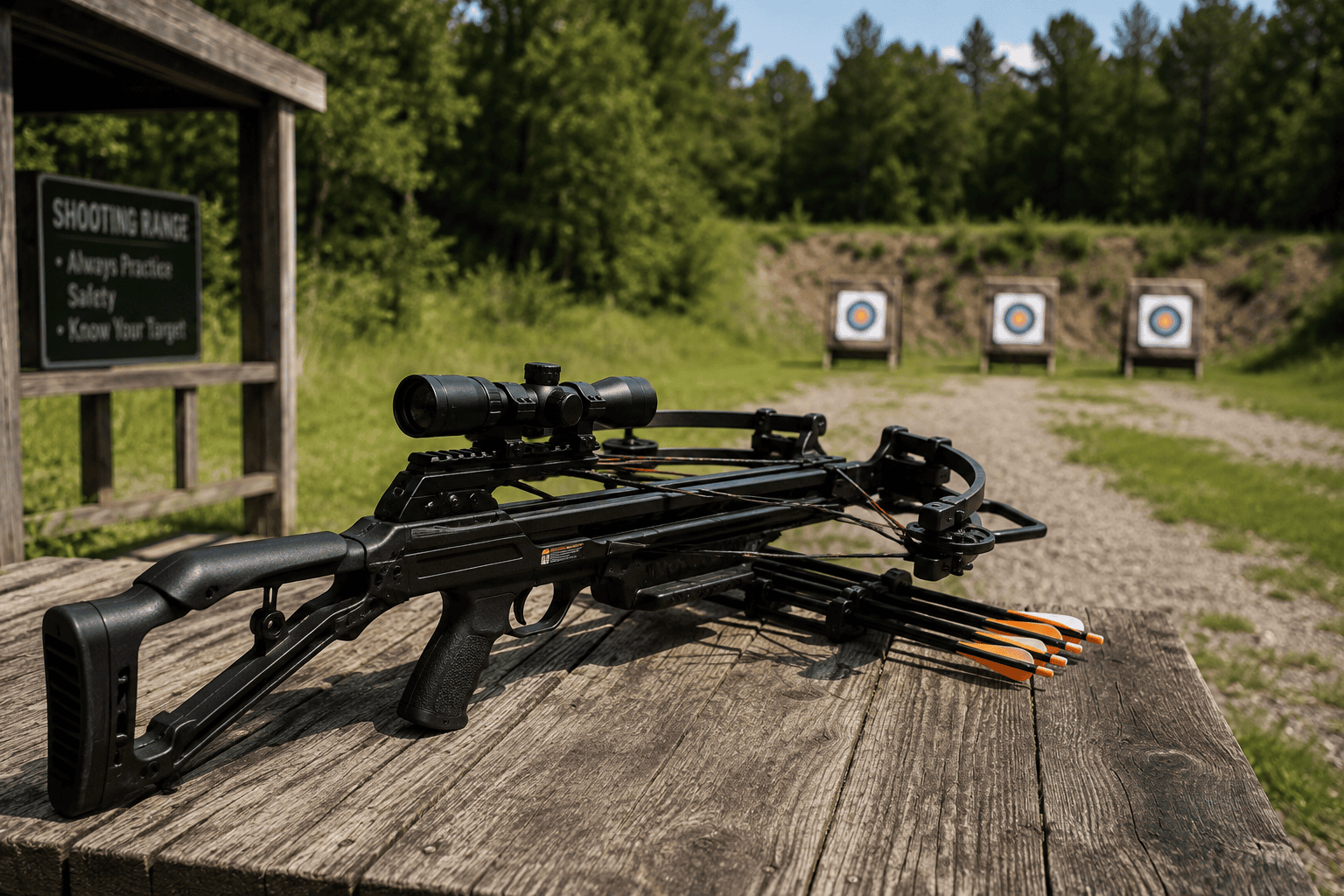
Modern crossbows are remarkably powerful. Even relatively affordable models can launch an arrow at well over 300 feet per second, while some high-end crossbows now exceed 500 FPS. But how powerful does a crossbow need to be in practice? For most buyers, the answer is probably less powerful than the marketing would have you believe.
Crossbow power isn’t simply about buying the model with the highest draw weight or fastest advertised speed. What matters is having enough energy for what you intend to do, while still choosing a crossbow that is accurate, manageable, safe to operate, and enjoyable to shoot.
For target shooting, you need considerably less power than you might expect. For hunting, sufficient kinetic energy and penetration become more important, but even here there is a point where extra speed provides diminishing practical benefits.
In this guide, we’ll look at draw weight, arrow speed, kinetic energy, arrow weight, hunting requirements, and whether today’s ultra-fast crossbows are actually worth buying.
Table of Contents
What Does Crossbow “Power” Actually Mean?
When manufacturers talk about crossbow performance, you’ll normally see several numbers prominently advertised:
- Draw weight
- Arrow speed in feet per second (FPS)
- Kinetic energy in foot-pounds (ft-lb)
- Power stroke
These measurements are related, but they don’t mean the same thing.
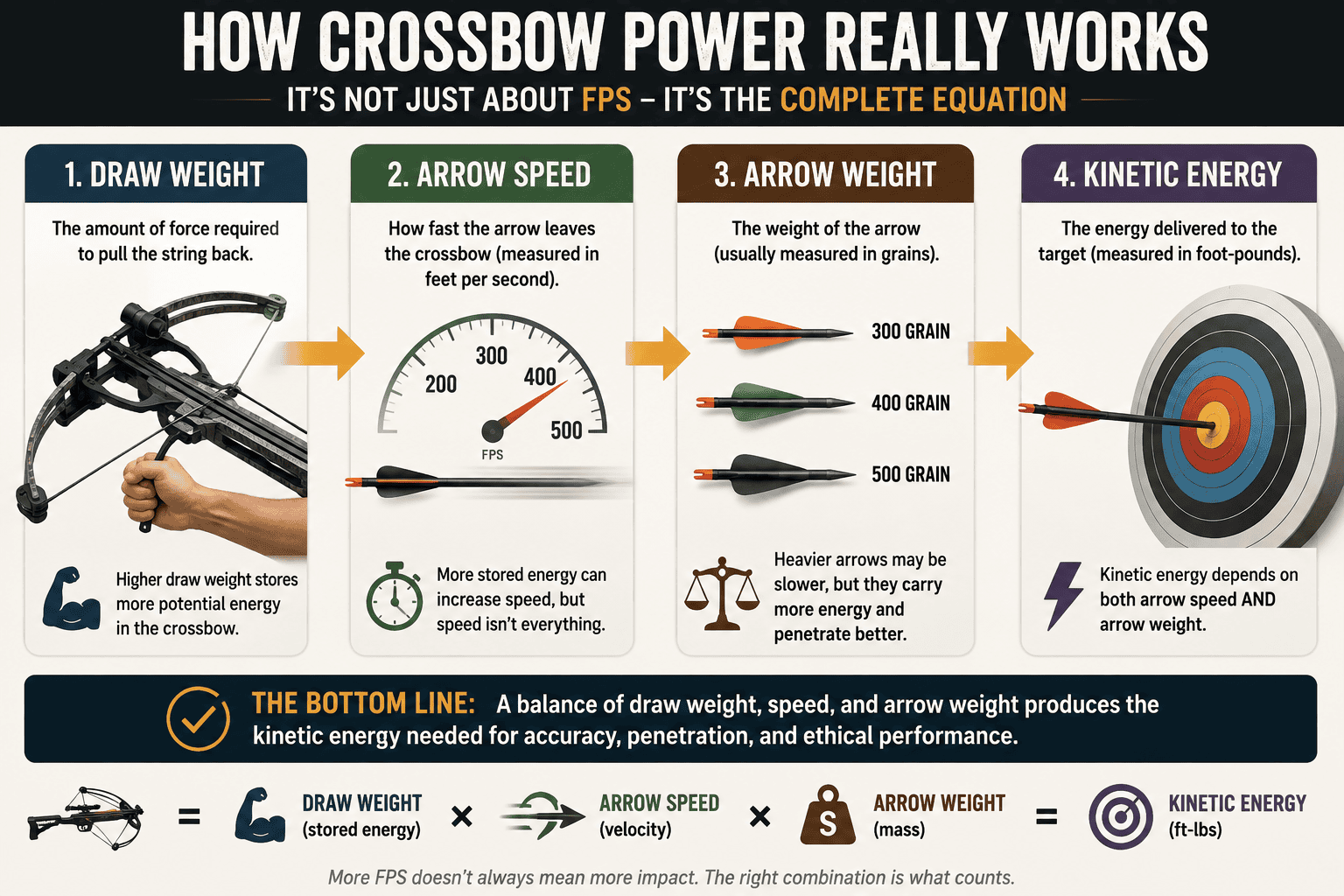
Draw Weight
Draw weight is the amount of force required to pull the crossbow string into its cocked position.
A crossbow with a 200-pound draw weight therefore requires significantly more force to cock than a traditional bow with a 50-pound draw weight — although modern cocking systems can dramatically reduce the physical effort required.
It’s important not to assume that a higher draw weight automatically means a proportionally more powerful crossbow.
Crossbow efficiency, limb design, cams and power stroke all affect how much of that stored energy ultimately reaches the arrow.
Arrow Speed
Speed is usually the number manufacturers advertise most aggressively.
You’ll commonly see figures such as:
- 300 FPS
- 350 FPS
- 400 FPS
- 450 FPS
- 500+ FPS
FPS simply means feet per second.
A crossbow rated at 400 FPS is theoretically capable of launching its specified test arrow at approximately 400 feet every second.
However, advertised speeds are generally achieved under specific test conditions and with particular arrow weights. Fit a heavier hunting arrow and your real-world speed will normally be lower.
Kinetic Energy
For hunting especially, kinetic energy can be more informative than FPS alone.
Kinetic energy describes the energy carried by the moving arrow and is normally expressed in foot-pounds.
It depends on both arrow speed and arrow weight.
That distinction matters.
An extremely light arrow travelling very quickly isn’t necessarily better than a somewhat heavier arrow travelling more slowly. A heavier arrow can retain substantial energy and provide excellent penetration even if it doesn’t produce the headline-grabbing chronograph figure.
How Powerful Does a Crossbow Need to Be for Target Shooting?
If you’re primarily interested in recreational target shooting, you don’t need a particularly powerful crossbow.
In fact, excessive power can sometimes make target shooting less convenient.
A modern crossbow shooting somewhere around 300–350 FPS already provides plenty of performance for normal recreational ranges. It will shoot relatively flat, provide satisfying performance and allow you to practise accuracy without needing the fastest crossbow available.
Higher speeds can certainly be useful when shooting at longer distances because the arrow reaches the target faster and follows a flatter trajectory.
But there is a trade-off.
More powerful crossbows can:
- Be more expensive
- Be harder to cock without assistance
- Place greater stress on strings and components
- Require more substantial targets
- Make arrows harder to remove from targets
- Be less forgiving of poor technique or unsuitable arrows
If you’re shooting at 20, 30 or 40 yards in your garden or at a range, buying a 500 FPS crossbow purely for the extra power usually isn’t necessary.
Here is an article about basic crossbow safety.
How Much Power Do You Need for Hunting?
This is where crossbow power becomes more important.
The objective when hunting isn’t simply to hit an animal. You need sufficient penetration to make an ethical shot when using an appropriate hunting arrow and broadhead.
Fortunately, modern hunting crossbows are extremely capable.
A useful general benchmark for deer-sized game is roughly 40 ft-lb of kinetic energy or more at the target, although requirements and recommendations vary according to the species, equipment and jurisdiction.
Many modern crossbows comfortably exceed this.
For example, a 400-grain arrow travelling at 300 FPS produces roughly 80 ft-lb of kinetic energy at launch. Increase the speed to 350 FPS and you’re approaching 109 ft-lb.
That gives you some idea of how much energy modern crossbows can produce.
As a broad practical guide:
| Intended Use | Useful Performance Range |
| Recreational target shooting | 250–350+ FPS |
| General target/3D shooting | 300–400 FPS |
| Deer-sized game | 300–400+ FPS / sufficient legal KE |
| Larger game | Higher KE with suitable heavy arrows |
| Long-range target shooting | 350–450+ FPS can be beneficial |
These shouldn’t be treated as legal hunting requirements. Hunting regulations vary enormously between countries, states and provinces, and some jurisdictions specify minimum draw weights, arrow dimensions or other equipment requirements.
Always check the current regulations where you intend to hunt.
Draw Weight Doesn’t Tell the Whole Story
It’s tempting to compare two crossbows based purely on draw weight.
Imagine one crossbow has a draw weight of 175 pounds and another has a draw weight of 220 pounds.
You might naturally assume the 220-pound crossbow is dramatically more powerful.
Not necessarily.
Crossbow design has changed significantly, particularly with modern compound systems. Cam design, limb efficiency and power stroke all influence how efficiently stored energy is transferred into the arrow.
This is why FPS and kinetic energy should be considered alongside draw weight rather than looking at draw weight alone.
Draw weight does, however, matter when it comes to cocking the crossbow.
A high-powered crossbow can require considerable force to cock manually. Rope cocking devices reduce that effort significantly, while crank systems can make even extremely powerful crossbows manageable for shooters who would never be able to cock them by hand.
It also matters what type of crossbow you use. Here is an article discussing the differences between recurve and compound crossbows.
Arrow Weight Is Just as Important as Crossbow Speed
One of the biggest mistakes beginners can make is focusing entirely on FPS.
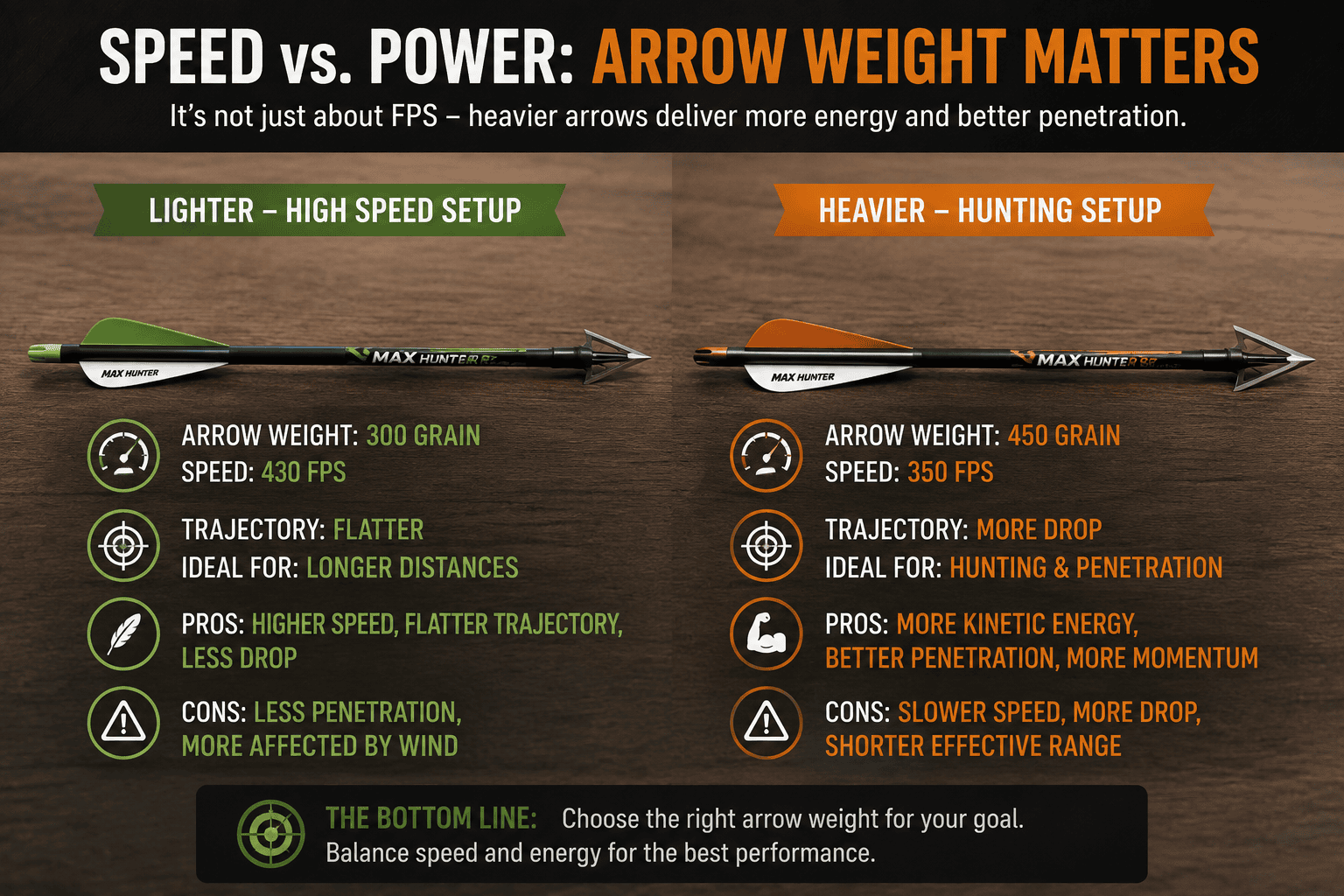
Suppose Crossbow A launches a lightweight arrow at 430 FPS while Crossbow B launches a heavier arrow at 380 FPS.
Looking at the box, Crossbow A appears substantially more powerful.
But speed is only part of the equation.
A heavier arrow can carry considerable kinetic energy and momentum, potentially improving penetration while also absorbing more of the crossbow’s stored energy.
Heavier arrows can also offer other benefits, including reduced noise and vibration.
There is obviously a limit. Go excessively heavy and trajectory becomes increasingly curved, making accurate range estimation more important.
The goal is therefore balance.
You want an arrow heavy enough to provide good energy transfer and penetration without unnecessarily sacrificing trajectory.
Most importantly, always follow the crossbow manufacturer’s minimum arrow-weight specification. Using an arrow that is too light can place excessive stress on the crossbow because insufficient energy is transferred into the projectile.
How Fast Should a Beginner’s Crossbow Be?
For most beginners, I would look in the region of 300–400 FPS rather than automatically chasing the fastest crossbow available.
That’s already a huge amount of performance.
A crossbow shooting around 350 FPS can provide:
- Plenty of power for target shooting
- A relatively flat trajectory at normal distances
- Sufficient energy for many hunting applications where legal
- More affordable equipment options
- Less emphasis on extreme performance
There are excellent crossbows that shoot considerably faster, of course. The point isn’t that 400+ FPS is bad.
It’s simply that beginners shouldn’t assume they need it.
Accuracy, trigger quality, scope quality, balance, reliability, cocking system and safety features may make a much bigger difference to your experience than another 30 or 40 FPS.
Here are the best crossbows for beginners.
Is a 400 FPS Crossbow Powerful Enough?
Absolutely.
A genuine 400 FPS crossbow is an extremely capable piece of equipment.
Using a 400-grain arrow, a theoretical 400 FPS launch speed represents approximately 142 ft-lb of kinetic energy.
Real-world velocity and downrange energy will be lower, but that still illustrates just how powerful modern crossbows have become.
For the majority of shooters, 400 FPS sits in something of a sweet spot.
It’s fast enough to provide a relatively flat trajectory while avoiding the need to enter the increasingly specialised 450–500+ FPS category.
For recreational shooting, 400 FPS is arguably more than you actually need.
For hunting, it can provide substantial energy when paired with the correct arrow and broadhead.
Do You Need a 500 FPS Crossbow?
Probably not.
That doesn’t mean you shouldn’t buy one.
Ultra-fast crossbows are impressive pieces of engineering, and there are legitimate advantages to increased velocity.
A faster arrow spends less time in flight and follows a flatter trajectory. That means small errors in range estimation can have less effect on point of impact.
At longer distances, that can be useful.
But speed doesn’t eliminate the fundamental challenges of crossbow shooting.
A 500 FPS crossbow still requires accurate range estimation, good shooting technique, a properly calibrated scope and suitable arrows.
For hunting, even extreme speed doesn’t make very long shots automatically ethical. Animals can move between the trigger being pulled and the arrow arriving, while wind, branches and other environmental factors introduce additional uncertainty.
There are also practical disadvantages to extreme performance.
Faster crossbows tend to be expensive, and increased speed can place greater demands on strings, cables, arrows and targets.
For most buyers, there is far more value in purchasing a high-quality 350–425 FPS crossbow with a good trigger, reliable cocking mechanism and decent scope than chasing maximum speed purely because the number looks impressive.
Don’t Confuse Power With Effective Range
This is another important distinction.
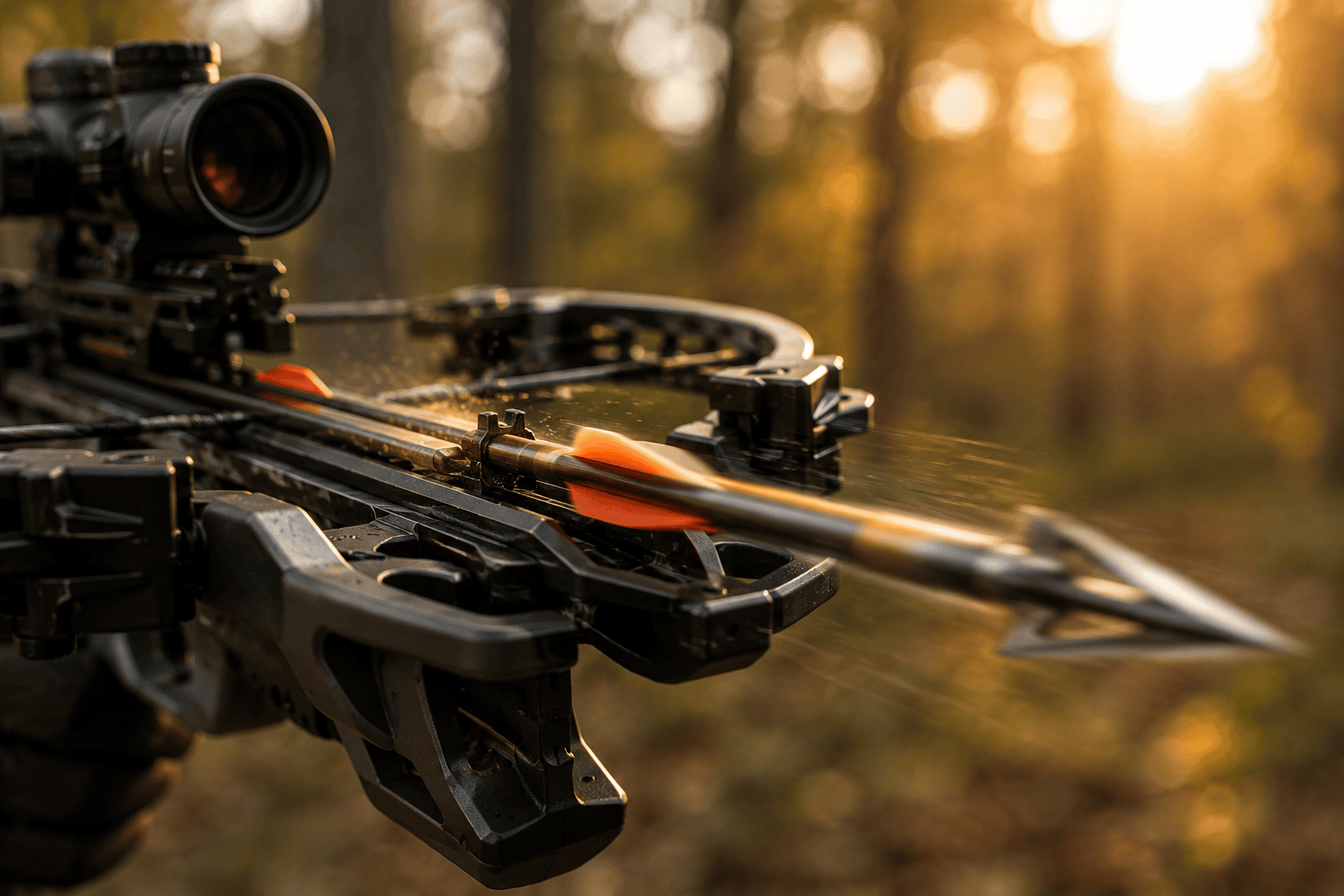
A crossbow may be physically capable of sending an arrow well beyond 100 yards.
That doesn’t mean 100 yards is its sensible hunting range.
For target shooting, stretching the distance can be great fun. You’re shooting at a stationary target and can compensate for arrow drop.
Hunting is different.
Even if an arrow retains enough energy to penetrate effectively at longer distances, the animal can move while the arrow is in flight.
Crossbow Magazine notes that modern crossbows can retain more than enough energy for deer-sized game beyond 40 yards, but trajectory, animal movement and accurate shot placement become the real limiting factors.
In other words:
Maximum projectile range, maximum target range and maximum ethical hunting range are three very different things.
More power doesn’t change that.
Cocking Effort Matters More Than Many Buyers Expect
There’s little benefit in owning an extremely powerful crossbow if cocking it becomes an ordeal.
Modern draw weights can exceed 200 pounds and, in some cases, go considerably higher.
Fortunately, cocking devices make these forces manageable.
A rope cocking aid uses mechanical advantage to reduce the force required. Crank systems can reduce the effort even further and are particularly useful for high-powered crossbows.
When comparing crossbows, therefore, don’t just ask:
“How powerful is it?”
Also ask:
“How easy is it for me to cock repeatedly?”
That becomes particularly important during longer target sessions.
A slightly slower crossbow that you can comfortably cock, load and shoot repeatedly may ultimately be far more enjoyable than a faster model that becomes exhausting after ten shots.
More Power Can Mean More Wear
Crossbows store substantial amounts of mechanical energy.
As performance increases, strings, cables, limbs and other components operate under considerable loads.
That doesn’t mean powerful crossbows are inherently unreliable. Modern premium crossbows are specifically engineered to handle these forces.
However, extreme speed makes correct maintenance and arrow selection particularly important.
Always use arrows that meet the manufacturer’s specifications and regularly inspect:
- Strings
- Cables
- Serving
- Limbs
- Nocks
- Arrow shafts
Never attempt to gain additional speed by using arrows lighter than the manufacturer’s minimum specification.
What Power Crossbow Should You Buy?
For most people, I’d divide the market roughly like this:
Under 300 FPS
Perfectly usable for recreational shooting and some specialised applications, although performance is modest compared with modern hunting crossbows.
300–350 FPS
A very practical range for beginners and recreational shooters.
You get good performance without paying purely for headline speed.
350–400 FPS
Probably the sweet spot for many buyers.
Crossbows in this range offer excellent trajectory, substantial kinetic energy and plenty of hunting capability where legal.
400–450 FPS
High-performance territory.
These crossbows provide very flat trajectories and substantial energy, making them attractive to serious enthusiasts and hunters.
450–500+ FPS
Extreme performance.
They’re incredibly impressive, but most shooters don’t genuinely need this level of speed. You’re often paying a premium for cutting-edge engineering and maximum performance.
Check Your Local Crossbow Laws
If you’re buying a crossbow for hunting, power isn’t purely a performance question.
It can also be a legal one.
Crossbow hunting regulations vary significantly by location. Some jurisdictions specify minimum draw weights, while others regulate hunting seasons, broadhead dimensions, arrow specifications or which species can legally be hunted with a crossbow.
For example, some Canadian provinces impose minimum draw-weight requirements for certain game species, while regulations across US states differ considerably.
Never assume that because a crossbow is powerful enough to kill an animal, it is automatically legal to use for that purpose.
Here is a guide about crossbow hunting regulations by state. For readers outside the US, check your relevant government wildlife authority before hunting.
So, How Powerful Does a Crossbow Need to Be?
For most people, considerably less powerful than the fastest crossbows currently available.
If you’re primarily target shooting, 300–350 FPS is already plenty.
If you want a versatile crossbow for target shooting and hunting where permitted, the 350–400 FPS range is an excellent starting point.
Crossbows exceeding 400 FPS offer genuine performance advantages, particularly flatter trajectories, but they aren’t essential for the majority of shooters.
And 500 FPS?
It’s impressive. It’s exciting. But it’s a bit like buying a 200 mph sports car. The engineering is fantastic, but very few owners actually need all of the available performance.
Instead of chasing the biggest number on the box, look at the entire package: accuracy, trigger quality, reliability, cocking mechanism, arrow compatibility, weight, balance and safety features.
The best crossbow isn’t necessarily the most powerful one.
It’s the one that provides enough power for what you actually intend to do — and allows you to put the arrow exactly where it needs to go.